Introduction
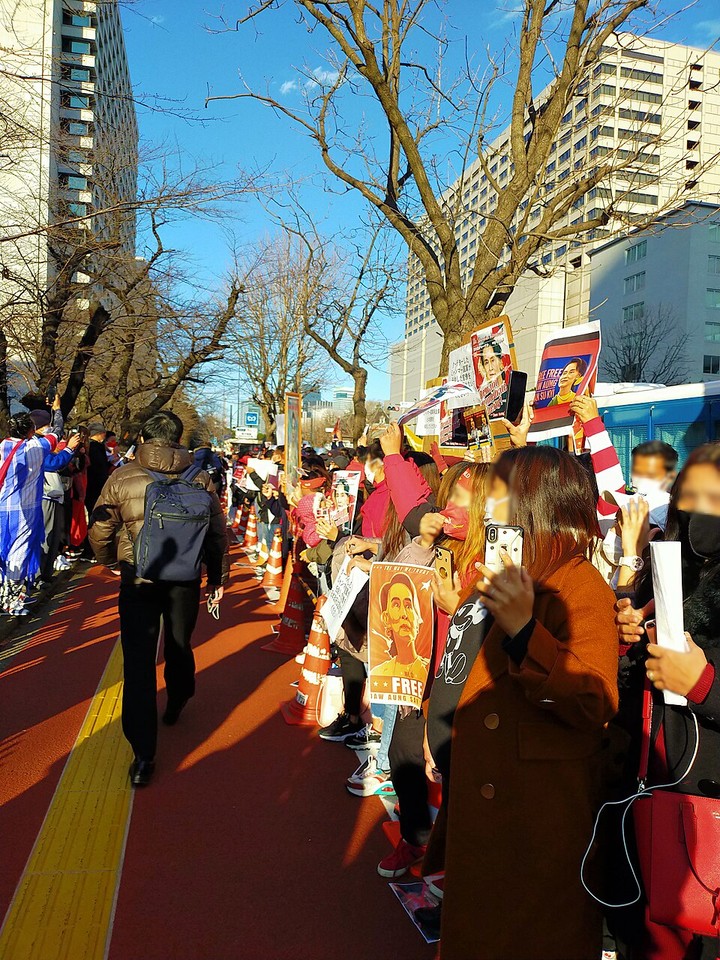
Myanmar occupies a strategically important position in Japan's vision for a Free and Open Indo-Pacific. Historical ties between the two countries have long been reflected in Japan's extensive Official Development Assistance (ODA) to Myanmar, although this relationship changed after the 2021 military coup. While Japan took certain actions to downgrade its representation at events organized by the military regime and suspended non-humanitarian development assistance, it continued to subtly engage with the junta and refrained from imposing sanctions.
The coup triggered severe political instability, economic decline, and growing insecurity, prompting large numbers of Myanmar citizens to seek opportunities abroad. Japan has emerged as one of the top destinations, especially for skilled laborers and youth. There was a threefold rise in the applications of Myanmar workers dispatched from agencies in the early 2021. Also, Japan was indicated as the most popular language studied in Myanmar at Duolingo showing the rising pattern of studying Japanese language after the coup.
Given the differences in culture, geographical context, and social norms between the two countries, migration to Japan may have significant cultural and psychological impacts on Myanmar migrants. This article examines the migration patterns and psychosocial challenges of the Myanmar diaspora in Japan, with the aim of identifying key areas that should be considered when designing diaspora engagement strategies.
Burmese migration to Japan
By June 2025, there were over 160,000 Myanmar people living in Japan, which is four times more than before the coup. For Myanmar people, Japan is perceived as more reliable and safer than Thailand and other countries due to its historical ties and continuous humanitarian assistance over the decades. Moreover, the large number of official agencies directly linked with Japanese universities and companies facilitates the transition to Japan, from the application and visa processes to the onboarding stage.
According to the results of the 2025 and 2024 International Student Surveys, the growth rate of Myanmar students in Japan was the highest among foreign student populations, at 77.2% and 113 % respectively. Unlike people from other nations who are drawn to Japan because of its economic and political stability, Myanmar youth are coming to Japan for survival and to escape the military coup and conscription law. And, this large-scale migration has led the media to describe the Myanmar diaspora community in Japan as “Little Yangon”.
However, despite its historic friendship ties, there are distinct cultural differences between the two societies, which hindered harmonious co-living of Burmese migrants in Japan. Also, while Japan sounds promising for life security before and in the beginning phase of military coup, the increasingly strict policy for immigration control has loosened this sentiment of security along with the emergence of anti-foreigner sentiment of the Takaichi government. With this, weakened governance in the home country, which contributes to visa vulnerability and financial stress, has challenged the overall psychosocial well-being of Myanmar migrants.
Myanmar migrant workers in Japan
Similar increasing migration patterns can also be found among Myanmar workers. Amid economic instability resulting from political instability, the number of Myanmar workers migrating to Japan in 2023 increased more than 60 times compared with 2021, highlighting the increasing number of people leaving the country after the coup. Unlike neighboring countries such as Thailand, Japan has been a common destination for skilled workers who have already graduated with bachelor’s degrees or are experts in specific fields. However, among the overall Myanmar labor force in Japan, many workers are employed in the manufacturing and nursing care sectors, which often face labor shortages.
According to the IOM’s labor migration report, Myanmar migrant workers account for 5% of the foreign labor force in Japan, making Myanmar one of the seven largest sources of foreign labor. More specifically, there are several labor migration pathways in Japan:
- Technical Intern Training Programmes (TITP), a practical skills training program for foreign nationals, with Myanmar workers accounting for 7% of its total workforce;
- Specified Skilled Worker Programme (SSWP) Types 1 & 2, a program work visas in Japan for skilled foreign workers, 10% of whom are from Myanmar; and
- Engineer in Humanities Services (EHS).
Myanmar students in Japan
In Japan, the number of international students in 2025 increased to 400,000, a 21.2% increase from 2024, exceeding the Japanese government’s 2033 target. While the majority of international students are still from China, the past year’s growth was driven mainly by students from Nepal and Myanmar. One reason behind this growth is reported to be fewer job opportunities in their home countries. Among the various educational tracks, from graduate and undergraduate programs to training colleges and Japanese language institutes, two common pathways are chosen by Myanmar students: training colleges and Japanese language institutes.
This is also evident in the 2025 International Student Survey in Japan, which shows an increase in international enrollment in language schools and training colleges alongside a particularly high increase in the number of Myanmar students. This is mainly related to competitive admission to Japanese universities and differences in high school educational qualifications among Myanmar students. In particular, differences between the high school education systems can affect the eligibility of Myanmar students for direct university admission, leading many Myanmar students to choose Japanese language schools as a pre-college pathway.
For Myanmar students, reasons for choosing Japan over other countries, such as Thailand and South Korea, include a sense of reliability and financial convenience, as well as postgraduate employment opportunities and the possibility of part-time work during their studies. Thus, studying in Japan offers students the possibility of earning their own living expenses throughout their academic life without consistently relying on their families. Specifically, Myanmar students account for 14% of foreign students working in part-time jobs nationwide, including both university and language school students.
At the same time, repeated references among Myanmar students to necessity and survival suggest that Japan may be, for many Myanmar people, more a country of security than a country of their dreams. This observation is also based on my own experience of seeing several Myanmar students who, after spending two to three years in Japan, chose to transfer to Thailand in search of a greater sense of home and happiness.
Growing difficulties for Burmese students
The recently introduced immigration control policies of the Takaichi government may affect some of the factors that have made Japan attractive to Myanmar migrants and could contribute to changing perceptions of Japan as a place of security. Some examples include higher requirements for permanent residence as well as new rules for language schools, such as stricter Japanese language requirements and checks on part-time employment. Significantly, the latter rules seek to ensure that the part-time working hours of foreign students do not exceed 28 hours per week, with quarterly checks, disclosure of employers’ names, and mandatory reporting.
Based on my own experience of observing Myanmar migrant groups in Japan on social media, exceeding permitted part-time working hours became a significant issue in June 2026. According to a social media post by a Myanmar visa service provider, nearly 30 Myanmar students were expelled from one language school just one day before their visas expired and a few days before completing their program. The case was partially mediated with the help of a service provider who consulted with Japanese authorities. Some students were deported, while others were allowed to continue their stay in Japan.
With these stricter regulations on international students and fewer opportunities to rely on part-time income, prospective and incoming students from Myanmar are facing a dilemma. This uncertainty also stems from concerns about their ability to cover the initial financial costs of studying in Japan, which are often financed through loans or the sale of family property, through part-time work as they had previously expected.
Image: Screenshot of the Facebook post of the Myanmar Visa-service provider in Japan
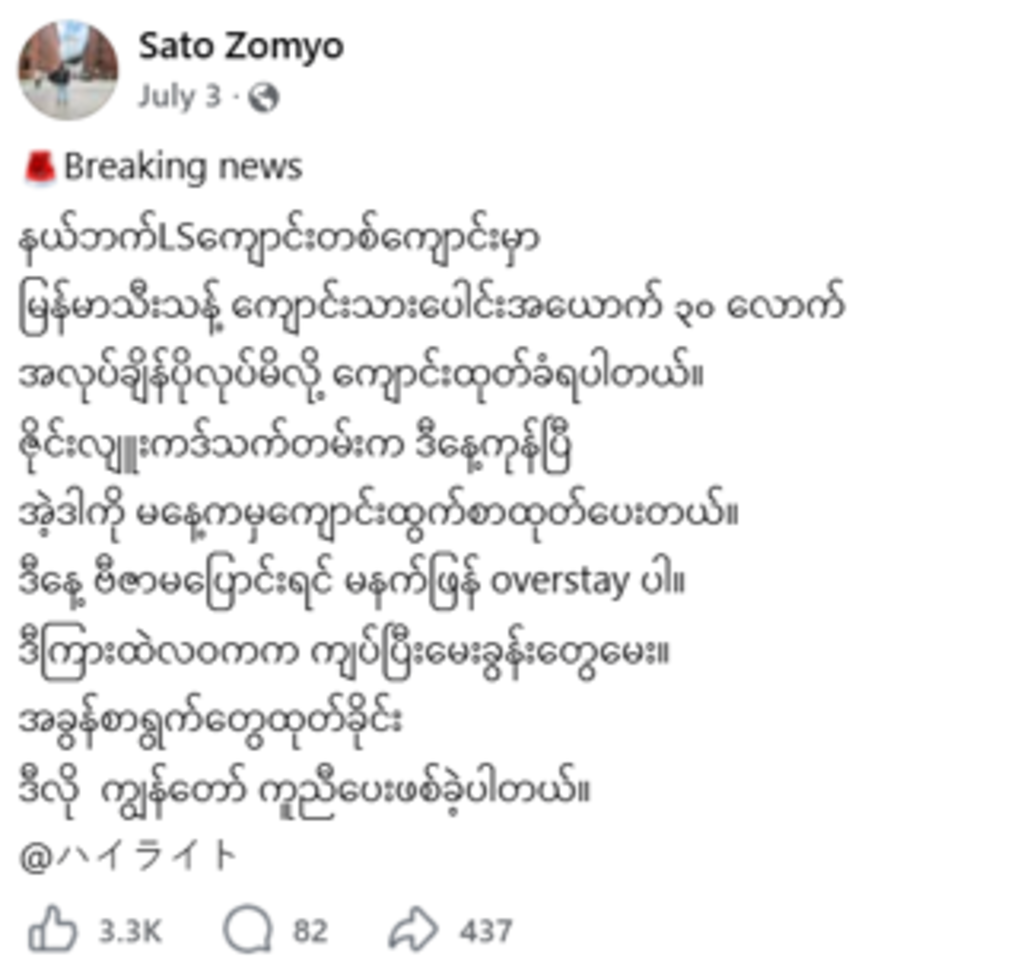
Breaking news: One language school near a rural area has expelled around 30 Myanmar students because they exceeded the permitted part-time working hours. Their Zairyu Cards will expire today, and the school provided the official expulsion documents only yesterday. According to the account, if they were unable to submit an application to extend or change their visa status that day, they would be considered overstayers from the following day. The students were also subject to extensive questioning by immigration authorities, including requests for tax-related documents. I assisted them with this process. (Translation by the author.)
Another manifestation of these changes affecting international students is the increase in tuition fees for international students from 2027 at some national universities, such as Tohoku University and the University of Tsukuba. This increase has been described as necessary to sustain university facilities and support for international students amid rapidly rising inflation. It has also been justified on the grounds that international students require additional support, such as assistance with visas and accommodation, while these costs have largely been borne by local students.
Recognition of refugee status
These difficulties are not limited to students but affect the broader Myanmar diaspora in Japan, including both students and workers. At the same time that concerns about anti-foreigner sentiment have been growing in Japan, the humanitarian crisis in Myanmar has continued to worsen. Following the activation of the conscription law in 2024, forced recruitment in Myanmar has intensified, with reports of people being taken shortly after arriving at the airport. As a result, Myanmar migrants may experience anxiety about persecution upon returning home and worry about whether they will be able to return safely.
At the same time, Japan’s policies towards foreign nationals have been changing under the Takaichi government’s approach of “orderly coexistence.” Some of these measures include Japanese language requirements related to permanent residence, policies affecting asylum seekers, and the Zero Illegal Foreign Resident Plan. In particular, the number of permanent residents in Japan has not increased at the same rate as the total number of foreign nationals. There has also been an acceleration of repatriation procedures and an increase in deportations by 30%, alongside high rejection rates for asylum seekers.
In numerical terms, Japan recognized only 187 applicants as refugees out of 14,832 asylum seekers. Among applicants from Myanmar, only 9 people were recognized as refugees out of 1,490 applicants, amounting to just 0.6%. This recognition system has been described as incomprehensible by Shogo Watanabe, who has been monitoring Burmese refugees since 1992. According to him, contributing factors include refugee protection being handled by the same authorities responsible for immigration and emigration control and the involvement of political considerations, including those related to Myanmar’s 2008 Constitution and 2010 elections. Therefore, it is important to consider Myanmar’s complex political landscape throughout its history when assessing refugee protection, as well as to reconsider Japan’s structures and procedures for refugee protection.
Psychosocial challenges of the Burmese diaspora in Japan
In terms of psychological well-being, stressors include economic insecurity caused by stricter visa regulations and limitations on working hours, such as the 28-hour weekly limit, particularly for those migrating as students and technical interns. There are also signs of depression among Myanmar migrant workers associated with isolation, including fewer opportunities to communicate with Japanese co-workers because of language barriers and the pressure to adapt to a highly disciplined working environment. Thus, cultural barriers may also contribute to the psychological challenges faced by Myanmar migrants.
This cultural dynamic between the two countries, especially in the migration context, can be examined through Berry’s (1992) Acculturation Theory, which identifies four acculturation strategies: integration, assimilation, separation, and marginalization. Differences in cultural practices can therefore influence how migrants adapt to and interact with the host society. One relevant example is conflict management style. Myanmar people tend to manage conflict through integrating and obliging styles, while Japanese people tend to favor compromising and dominating styles, depending on the level of intimacy involved. Awareness of such differences may therefore help Myanmar migrants navigate their lives in Japan and their interactions with Japanese communities. At the same time, successful integration does not depend solely on migrants. Japanese communities and workplaces also have a role to play, including by addressing discriminatory practices affecting foreign workers, as identified, for example, in a study of Vietnamese workers in Japan.
There is potential for greater cultural integration between Myanmar migrant communities and Japanese host communities. In this process, Myanmar service providers, such as those assisting with visa extensions and job applications, could potentially serve as mediators because of their existing connections with migrant communities. However, the ongoing political crisis and the lack of a diaspora engagement plan make systematic cultural integration more difficult. As a result, existing cultural and social patterns within migrant communities may persist rather than developing into more balanced forms of cultural adaptation.
Thus, there is a significant need for psychosocial support and cultural integration measures for the Myanmar diaspora in Japan to help migrants cope with existing political trauma and ongoing cultural differences. In doing so, relevant Japanese institutions could take the initiative or collaborate with non-governmental and other organizations, such as the Japan Foundation and psychosocial care organizations in Japan such as Tokyo Soteria, to facilitate deeper cultural connections with the Myanmar community.
Conclusion
In conclusion, compared with other countries, Japan has become an important destination for Myanmar skilled laborers and students due to its strong economy, educational opportunities, and prospects for employment. However, stricter policies affecting foreigners, including high rejection rates for asylum seekers, higher requirements for permanent residence, and tighter controls on students’ part-time working hours, may affect Japan’s attractiveness to Myanmar migrants and their perception of Japan as a secure destination.
At the same time, cultural differences in Japan and continuing political turmoil in Myanmar can contribute to the psychological distress experienced by the Myanmar diaspora. Thus, when designing Myanmar diaspora engagement plans in Japan, it is important to include both cultural integration measures and psychosocial support for people of different ages, while also taking into account Myanmar’s complex political circumstances.